Est. 1861 | Denver
CAMP WELD
An 1864 peace council, the Sand Creek Massacre and the ground beneath a new stadium and a changing Denver.
Why Camp Weld Matters Now
Camp Weld’s historic 30-acre footprint likely overlaps Burnham Yard, where the Denver Broncos are planning a new stadium and surrounding district. The Camp Weld marker at Eighth Avenue and Vallejo Street also stands within Denver’s much larger Burnham Yard Small Area Plan project area, where the city is now planning for the long-term future of the railyard and surrounding neighborhoods.
As Denver makes decisions that could shape this landscape for generations, there is an opportunity to better understand what happened here—and to ensure Camp Weld, its connections to the Sand Creek Massacre, and the people whose histories are tied to this land remain part of the story.
Remember the land. Tell the story.
They Sought Peace at Camp Weld
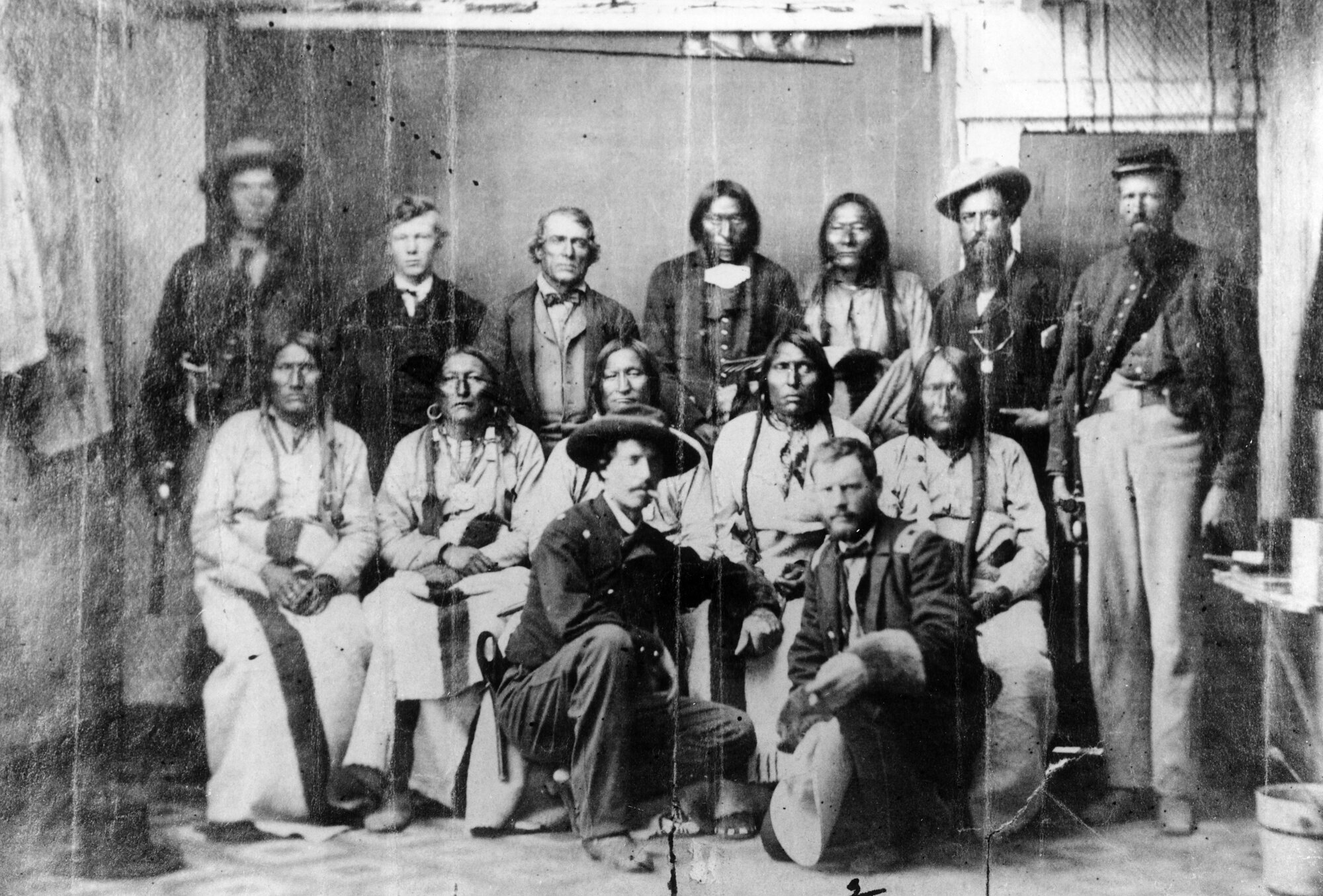
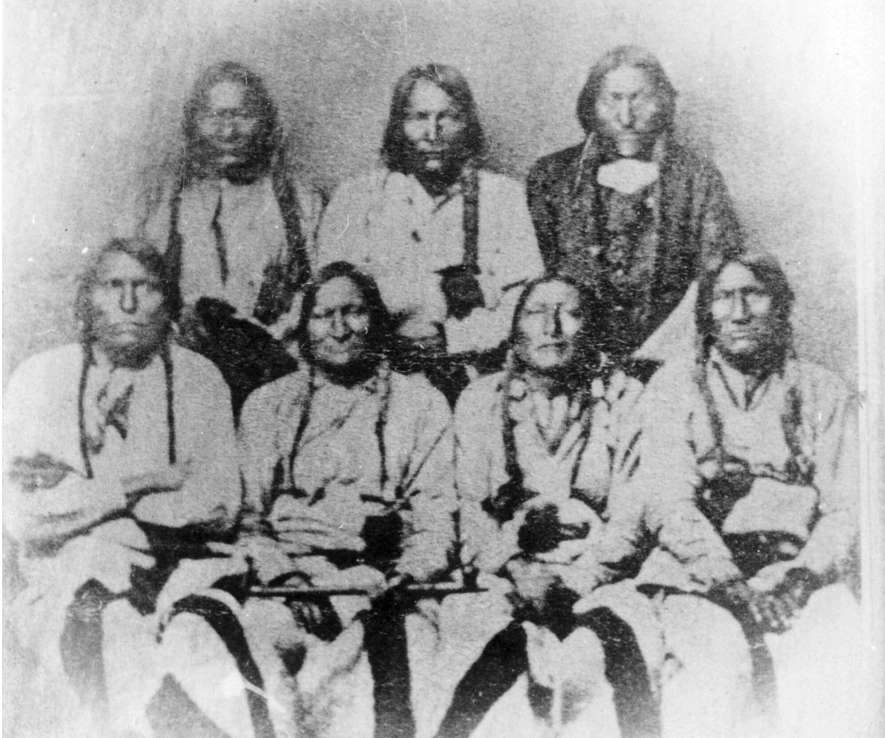
On Sept. 28, 1864, Cheyenne Chiefs Black Kettle, Bull Bear, and White Antelope, and Arapaho Chiefs Neva, Nat-an-ne, Bossee, and Heap of Buffalo traveled to Camp Weld and met with Gov. John Evans and Col. John Chivington to seek peace.
“They told us [Camp Weld] if we went to Big Sandy Creek and stayed there, we would be considered peaceful and would be protected by U.S. troops,” Cheyenne and Arapaho Tribal elders said in a Sand Creek Massacre exhibit now at History Colorado. “But Evans and Chivington betrayed us in the worst possible way. Just months later, more than 230 peaceful Cheyenne and Arapaho women, children, and elders were murdered at Big Sandy Creek by U.S. troops.”
Learn more about Camp Weld and its role in the Sand Creek Massacre.
- We are the Land by the City and County of Denver
- John Evans Study Report by the University of Denver
- Sand Creek: Tragedy and Symbol by Gary Roberts
Where Was Camp Weld?
Using the current Camp Weld marker at Eighth Avenue and Vallejo Street—the likely southwest corner of the camp—Camp Weld's historic 30-acre footprint likely extended north past Mulberry Street and east past Tejon Street in present-day Denver.
At least seven regional newspaper accounts published between 1901 and 1929 consistently placed Camp Weld on the Denver & Rio Grande shop grounds, today known as Burnham Yard (1901Open source: “where the Denver and Rio Grande shops are now located” (Rocky Mountain News (Colorado Historic Newspapers) · Jan. 27, 1901), 1908Open source: Camp Weld recollection (1908–09 account) (Rocky Mountain News (Colorado Historic Newspapers) · April 23, 1909), 1910Open source: Veteran recalls Camp Weld standing where the Burnham Yard shops now stand (Pueblo Sun (Colorado Historic Newspapers) · Jan. 8, 1910), 1920Open source: Camp Weld location account (1920) (Rocky Mountain News (Colorado Historic Newspapers) · July 11, 1920), 1923Open source: Camp Weld location account (1923) (Rocky Mountain News (Colorado Historic Newspapers) · Feb. 16, 1923), 1924Open source: Camp Weld location account (1924) (Rocky Mountain News (Colorado Historic Newspapers) · Aug. 6, 1924), 1929Open source: Camp Weld location account (1929) (Colorado Historic Newspapers · July 29, 1929)). In 1937, construction workers at Eighth Avenue and Vallejo Street excavated Civil War items just a few feet from the Camp Weld marker, including an old leather boot, a military bayonet, and a rusty gun barrel (1937Open source: Denver Post report on Civil War items excavated near Eighth and Vallejo (The Denver Post via NewsBank / Denver Public Library · February 1937)).
Today, the Denver Broncos are planning a new stadium at Burnham Yard in an area that may overlap Camp Weld's historic footprint, while the City and County of Denver is developing a long-term Small Area Plan for Burnham Yard and the surrounding area. As those processes unfold, this website was created to help Denver residents and people across Colorado understand Camp Weld—and the state's deep responsibility for atrocities committed at the Sand Creek Massacre.
Camp Weld Troops Helped Provoke 1864 White–Native Hostilities
Troops from Camp Weld played a key role in launching unprovoked attacks on Cheyenne People in the spring of 1864, precipitating a year of conflict that ultimately led to the Sand Creek Massacre. In April and May, soldiers led by Lt. George S. Eayre of McLain’s Independent Colorado Battery — based at Camp Weld, according to the 1910 article placing Camp Weld on present-day Burnham Yard — burned Cheyenne villages and participated in the murder of Lean Bear and another Cheyenne man on May 16, 1864.
At the Sept. 28 council, Cheyenne Chief White Antelope directly challenged Gov. John Evans at Camp Weld: “I would like for you to know that this was the beginning of war… as a [white] soldier fired first.” Lt. Clark Dunn, a 1st Colorado Cavalry officer, later confirmed this account in a 1909 interview.
Camp Weld Marker 1934 Installation
On Feb. 22, 1934, the State Historical Society of Colorado, the City and County of Denver, and the Mrs. J.N. Hall Foundation erected a three-ton granite monument to honor Camp Weld at West Eighth Avenue and Vallejo Street to mark that southwest corner. The marker’s public dedication ceremony, led by State Historical Society President Ernest Morris, included Colorado Gov. Ed C. Johnson and Denver Mayor George D. Begole. Elbridge B. Sopris, an unrepentant Sand Creek Massacre participant, attended as an honored guest.
The marker’s deteriorating plaque clearly communicates how 1930s Denver chose to remember Camp Weld’s connection to our people: “Headquarters Against Indians 1864-1865.”
Camp Weld Memorial Proposal & 1962 Structure Demolition
In July 1960, the Denver Post reported that a remaining Camp Weld building was located at the “west end of the W. 8th Ave. viaduct” and that it could be “considered the most historic structure left from Denver’s earliest days.” At the time, the building sat in an area proposed for “Urban Renewal clearance and redevelopment into an industrial area,” according to the newspaper.
Throughout 1961, Denver Urban Renewal Authority Director Robert Cameron exchanged letters with Colorado Historical Society President Maurice Frink regarding the memorial, with the state even developing two detailed sketches for a Camp Weld memorial. Despite public pleas to preserve the last likely surviving Camp Weld building, the state abandoned the memorial effort in 1962, and the city subsequently demolished the structure, leaving the 1934 granite monument as the only physical marker of Camp Weld’s historic footprint.
Camp Weld in Denver versus Fort Chambers near Boulder
Since March 2022, we have consulted on the City of Boulder’s Fort Chambers site, where Company D of the Third Colorado Cavalry mobilized before participating in atrocities in northeast Colorado (Oct. 10, 1864) and the Sand Creek Massacre (Nov. 29, 1864). The City of Boulder recently released an interpretive framework for the Fort Chambers site, following extensive community engagement, to guide an interpretive trail focused on learning, reflection, and the land’s connections to the Sand Creek Massacre.
We believe Camp Weld is just as important as Fort Chambers—and in many ways more important—and believe telling its story and its connections to the Sand Creek Massacre is important for the Denver community.
Camp Weld, Burnham Yard, Land Patents & Sand Creek
While Article 6 of the October 1865 Treaty of the Little Arkansas promised reparations to Sand Creek Massacre survivors — which never came — the federal government a month later issued patents over the Camp Weld and Burnham Yard area to men tied to the history of the Sand Creek Massacre.
Those include Alexander Cameron Hunt, who acquired a 160-acre federal land patent in February 1866, using a military bounty warrant issued to a man who served in a campaign against Native people. Serving as U.S. Marshal for Colorado Territory during the massacre — and later as Territorial Governor — Hunt testified before Congress about atrocities committed at Sand Creek. His patented tract now encompasses most of the historic Burnham Yard.
In November 1865, Langdon Clark received a U.S. land patent, initially awarded to another man for military service against Native People. He was a member of Company A, Third Colorado Cavalry, a Denver-based unit that participated in the Sand Creek Massacre. His 160-acre land patent lies immediately east of the railyard, covering much of what is now the La Alma Lincoln Park neighborhood. A month later, Elisha Milleson claimed a U.S. land patent under pre-emption rights after serving in Company A, Third Colorado Cavalry. His 40-acre land patent covered the western edge of Burnham Yard and likely much of Camp Weld’s historic footprint.
Denver’s Defense and Celebration of the Sand Creek Massacre
For generations, Denver and major Colorado institutions defended, celebrated, and memorialized the Sand Creek Massacre and the men who carried it out. In December 1864, soldiers returned to Camp Weld and later displayed scalps and other human remains as trophies in Denver, while the Denver City Council formally thanked the officers and soldiers who participated in the massacre.
Public support continued for decades, from an 1883 City Hall celebration honoring John Chivington to an 1898 Sand Creek reenactment at City Park and the Colorado Historical Society display of Chivington’s portrait and collection of Sand Creek “relics.”
The state further enshrined this memory by listing Sand Creek alongside Civil War battles on the Capitol monument in 1909 and by erecting the Camp Weld marker in 1934 with Sand Creek participant Elbridge Sopris as an honored guest. Even in 1941, Denver officials proposed naming a major street “Chivington Boulevard” — which the Denver City Council did not adopt following a protest from a State Representative who was a descendant of a chief killed at Sand Creek.