For generations, Coloradans blamed Cheyenne and Arapaho people for starting the violence of 1864, often tying the beginning of the conflict to the June 1864 killing of the Hungate family. But Colorado troops—including soldiers based at Camp Weld—had already escalated tensions by launching unprovoked attacks on Cheyenne people that spring, helping precipitate a year of conflict that ultimately led to the Sand Creek Massacre.
Trauma Warning
The history that follows is difficult. It includes accounts and historical quotations describing racial violence, military betrayal, murder, mutilation, the killing of women, children and elders, and racist and dehumanizing language connected to the Sand Creek Massacre.
This website limits graphic detail and examples where possible to reduce unnecessary trauma and harm. But understanding Camp Weld requires confronting a hard and painful history of Denver, Colorado and the Sand Creek Massacre—including violence against Cheyenne and Arapaho people and the ways that violence was later defended, celebrated and commemorated.
Readers who continue should do so with that understanding.
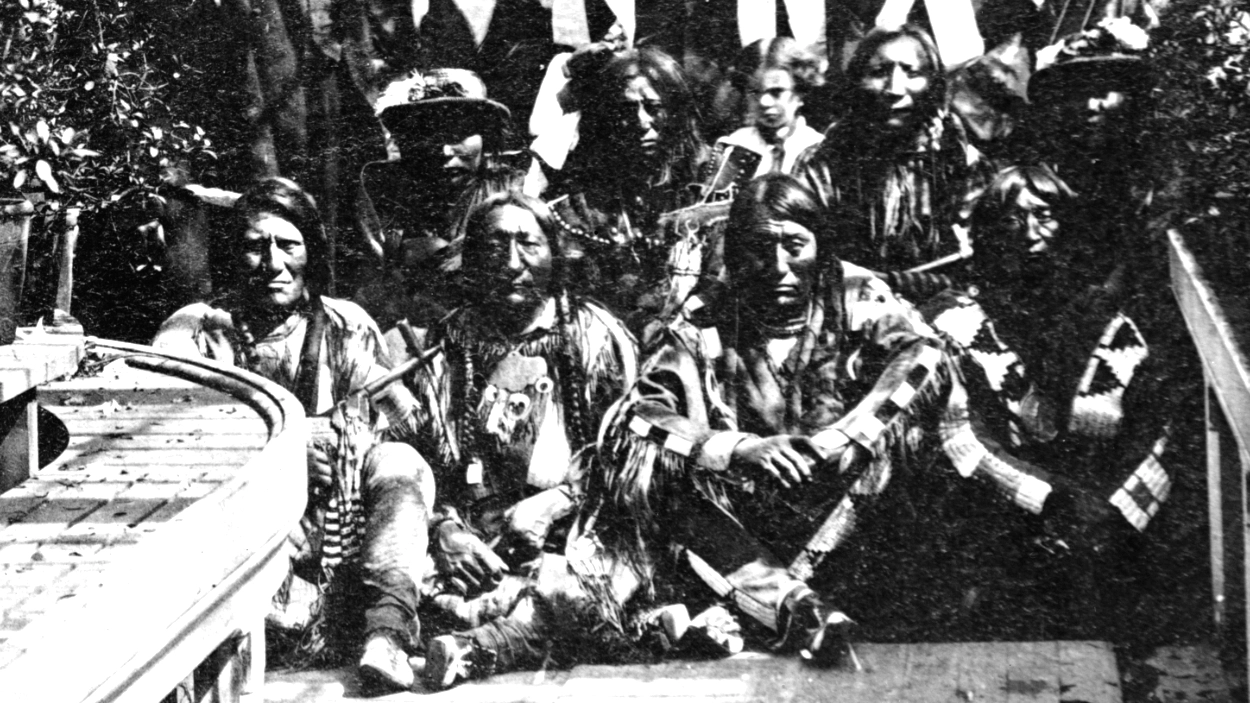
Cheyenne and Arapaho leaders, including Cheyenne Chief Lean Bear, traveled to Washington, D.C., in 1863 seeking peace. The following spring, Colorado troops—including soldiers based at Camp Weld, according to historical sources—launched unprovoked attacks on Cheyenne people that triggered retaliatory raids and disrupted supplies to present-day Front Range settlements. On May 16, 1864, Lean Bear rode out to meet soldiers wearing a peace medal, but troops based at Camp Weld murdered him, according to an account by George Bent published in the Denver Post in 1905.
Western History Collection, Denver Public Library
Camp Weld Troops Helped Provoke1864 Hostilities
Camp Weld Troops and the Killing of Lean Bear — How soldiers tied to Camp Weld burned Cheyenne villages and killed Chief Lean Bear in May 1864 as he rode out wearing a peace medal from Abraham Lincoln.
In April and May, soldiers led by Lt. George S. Eayre of McLain’s Independent Colorado Battery—based at Camp Weld, according to a 1910 newspaper account—burned Cheyenne villages and participated in the murder of Lean Bear and another Cheyenne man in mid-May 1864. In a 1905 Denver Post article, George Bent wrote that Lean Bear, who had received a peace medal from Abraham Lincoln during an 1863 visit to Washington, carried papers showing that he was friendly.
Bent, who was living among the Cheyenne before the Sand Creek Massacre, then wrote of Eayre: “He let the chief come up close, then ordered his men to fire. Then the troops shot Lean Bear to pieces as he lay on his back on the ground.”
Jacob Downing and May 1864 Attacks on Cheyenne — How Jacob Downing, whose name still marks a Denver street, tortured a Native man for information and then attacked a Cheyenne village in early May 1864.
Elsewhere, Colorado troops from Denver were escalating violence in the spring of 1864. On May 2, 1864, Jacob Downing—a proud Sand Creek Massacre participant whose name is still on a major city thoroughfare—tortured a Native man to learn the location of a Cheyenne camp. The next day, he led his men to attack the village, with Downing claiming his troops had killed 25 people.
Amid this violence, George Bent, who was living among the Cheyenne before the Sand Creek Massacre, said in the 1905 Denver Post article: “These attacks, and especially the killing of Lean Bear, made the Cheyennes very angry… They began fighting.”
“A White Soldier Fired First” — How Cheyenne Chief White Antelope and a Colorado cavalry officer both said soldiers, not Native people, fired the first shots of the 1864 war.
At the Sept. 28 council at Camp Weld, Cheyenne Chief White Antelope directly challenged Gov. John Evans: “I would like for you to know that this was the beginning of war… as a [white] soldier fired first.” Lt. Clark Dunn, a 1st Colorado Cavalry officer who ordered soldiers to fire in northeast Colorado on April 11, 1864—which an 1867 Indian commission identified as the first start of the 1864 conflict—later confirmed this account in a 1909 interview.
Camp Evans North of Camp Weld — A separate military camp where Third Colorado Cavalry soldiers gathered before many marched to Sand Creek.
Camp Weld was part of a larger Denver military landscape connected to the events leading to Sand Creek. Camp Evans was a separate, temporary military camp from Camp Weld, likely named for Gov. John Evans. It was possibly located in the area near present-day Interstate 70 and Washington Street. It was established on Aug. 24, 1864, about 2 1/2 miles down the South Platte from Denver, and became the main tent camp for much of the newly organized Third Colorado Cavalry during the fall of 1864, according to a diary from Hal Sayr of Gilpin County.
By Sept. 5, newspapers reported about 600 Third Regiment soldiers at Camp Evans “awaiting orders” and preparing to “start on the savage war path.” On Sept. 26, soldiers from the camp paraded through Denver and stopped at Gov. John Evans’ residence, where he praised their service and told them Col. John Chivington would lead them to “hunt out with skill” and pursue and “destroy” hostile Native people.
Two days later, while Cheyenne and Arapaho leaders were seeking peace at Camp Weld, reports of a possible peace nearly caused a mutiny among Third Colorado Cavalry volunteers at Camp Evans.
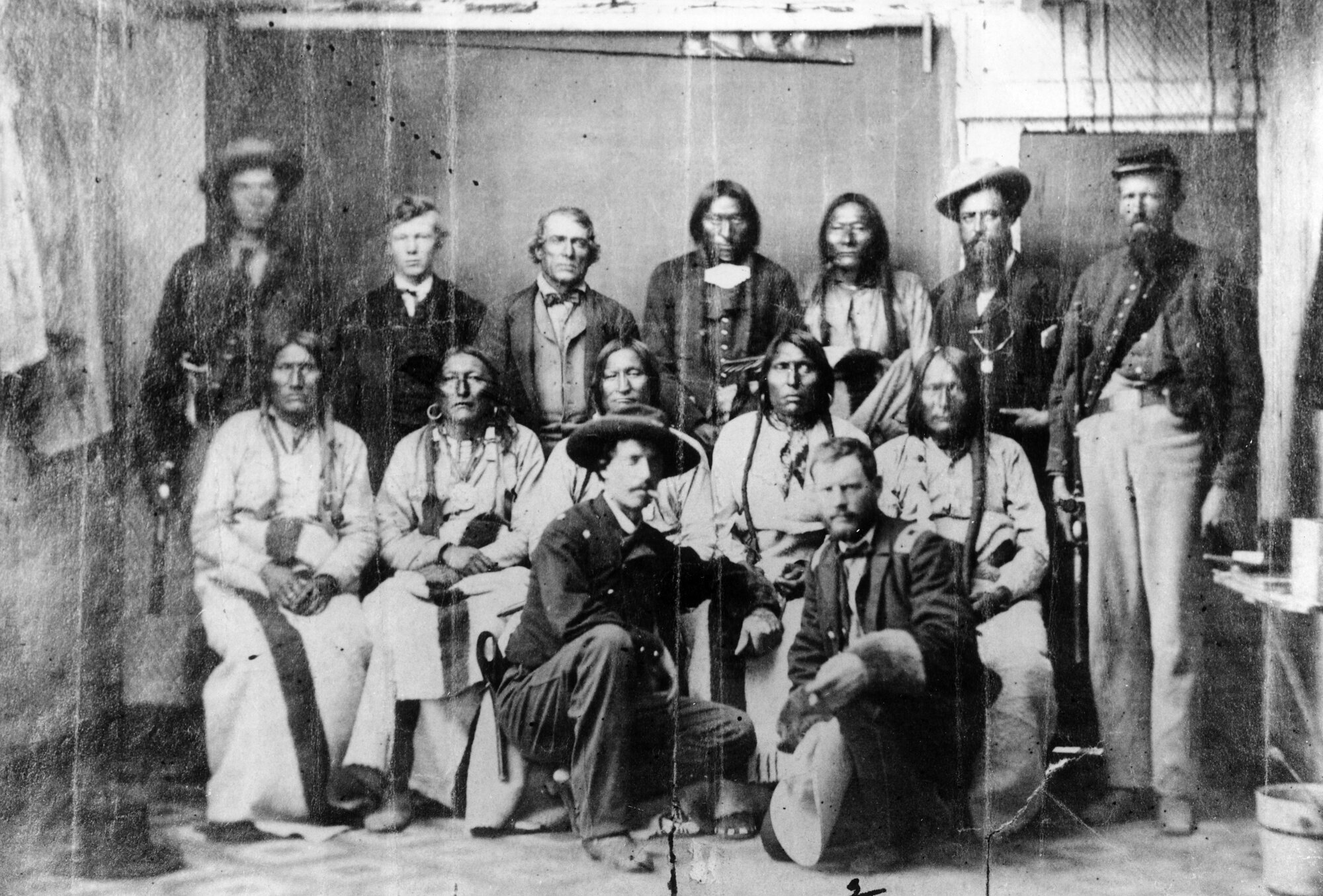
People shown in the photograph are identified as follows: kneeling, left to right: Maj. Edward Wynkoop and Capt. Silas S. Soule. Seated, middle row, left to right: White Antelope (Cheyenne), Bull Bear (Cheyenne), Black Kettle (Cheyenne), Neva (Arapaho), and Knock Knee (Arapaho). Standing, top row, left to right: unidentified, unidentified, John Smith, unidentified, Heap of Buffalo (Arapaho), Bosse (Arapaho), Dexter Colley, and unidentified. Continue below to learn what happened to the people who gathered at Camp Weld.
Western History Collection, Denver Public Library
Cheyenne and Arapaho People Sought Peace at Camp Weld
On Sept. 28, 1864, Cheyenne Chiefs Black Kettle, Bull Bear and White Antelope, and Arapaho Chiefs Neva, Nat-an-ne, Bossee and Heap of Buffalo met with Gov. John Evans and Col. John Chivington at Camp Weld to seek peace. Their journey to Denver carried immense personal risk. In mid-August, Evans had issued an infamous proclamation calling on citizens to join the Third Colorado Cavalry and “pursue, kill and destroy hostile Indians that infest the Plains for thus only can we secure a permanent peace.”
A Council Documented by Historians — Where Denver's own landmark study, the University of Denver's Evans report and other histories document the Camp Weld council's significance.
The historical significance of the September Camp Weld peace council has been extensively documented in books, public-history studies and academic reports, including:
- “We are the Land” by the City and County of Denver
- “John Evans Study Report” by the University of Denver
- “Sand Creek: Tragedy and Symbol” by Gary Roberts
Coloradans, as Morse Coffin of present-day Longmont recalled, were in no mood for peace: “At the time the 3rd Colorado Regiment was raised, the idea was very general that a war of extermination should be waged.”
I Came Here to Seek Peace and Nothing Else — What Black Kettle, Neva and other leaders said inside the Camp Weld council, and how troops camped nearby reacted to talk of peace.
Before the Camp Weld council began, Major Edward Wynkoop met privately with Evans. Wynkoop—who had convinced Cheyenne and Arapaho leaders to travel to Camp Weld—later testified that Evans told him: “[The Third Regiment] had been raised to kill Indians and they must kill Indians,” and later asked, “What shall I do with Third Regiment, if I make peace?”
During the council with Evans and Chivington, Cheyenne Chief Black Kettle eloquently asked for conciliation: “We have come with our eyes shut, following [Major Wynkoop's] handful of men like coming through the fire. All we ask is that we may have peace with the whites.”
Arapaho Leader Neva—who was sent to Camp Weld by his brother, Chief Nowoo3 (“Niwot,” Left Hand)—also came seeking peace: “I am determined always to keep peace with the whites. Now, when I shake hands with them they seem to pull away. I came here to seek peace and nothing else.”
Nearby at Camp Evans, where much of the Third Colorado Cavalry was camped, news that peace might be reached at Camp Weld reportedly caused such anger among the soldiers that the camp nearly erupted in mutiny. Many of those soldiers would later participate in the Sand Creek Massacre. The Rocky Mountain News, however, assured them they would still have an opportunity to fight Native people.
Peace Was Refused — How Gov. John Evans rejected peace at Camp Weld and how a 2014 University of Denver report later judged his actions.
Ultimately, Evans refused to make peace at Camp Weld. After the conference at Camp Weld, Evans wrote: “I have declined to make any peace with them, lest it might embarrass the [Third Regiment] military operations against the hostile Indians of the plains… My talk with them was for the purpose of ascertaining their views, and not to offer them anything whatever.”
The 2014 University of Denver report examining Evans’ actions in 1864—including a full chapter on the September Camp Weld conference—concluded: “Evans abrogated his duties as superintendent, fanned the flames of war when he could have dampened them, cultivated an unusually interdependent relationship with the military, and rejected clear opportunities to engage in peaceful negotiations with the Native peoples under his jurisdiction.”
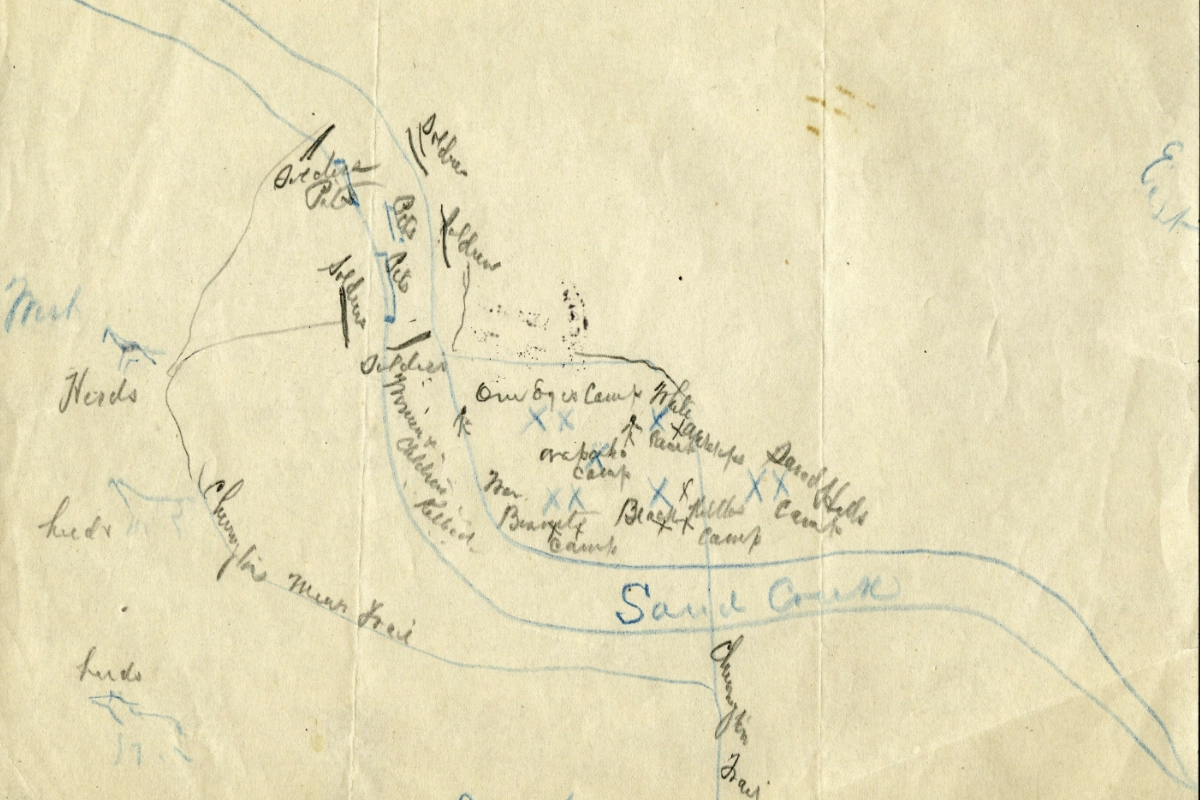
George Bent, a survivor of the Sand Creek Massacre, later drew maps of the attack showing the Cheyenne and Arapaho village, the sandpits where people sought protection and the movements of Colorado troops. Bent’s maps became important historical evidence in later efforts to locate and understand the massacre site.
Bent-Hyde Papers, Rare and Distinctive Collections, University of Colorado Boulder Libraries
From Camp Weld to the Sand Creek Massacre
Had Gov. John Evans taken a conciliatory approach at Camp Weld, Colorado history might have unfolded very differently. Cheyenne and Arapaho leaders had come to Denver asking for peace, and Evans had an opportunity to pursue it. He refused.
Chivington Marches Toward Big Sandy Creek — How Chivington sealed off Fort Lyon and overruled the officers who warned him that attacking the surrendered camp would be murder.
Instead, Evans handed his responsibility to make peace at Camp Weld to John Chivington. Following a covert march across snow-covered plains, Col. John M. Chivington's command surprised the garrison at Fort Lyon near present-day Lamar, Colo., on the morning of Nov. 28, 1864, immediately sealing the post with a picket line to prevent anyone from warning the Native camps.
During the evening of Nov. 28, Lt. Joseph A. Cramer, supported by other dissenting officers at Fort Lyon, directly confronted Chivington and warned him that attacking the surrendered camp would constitute murder. Enraged by the opposition, Chivington paced the room and cursed men sympathetic to Native people. That night, Chivington ordered men of the Third Colorado Cavalry and First Colorado Cavalry toward the Cheyenne and Arapaho camp at Big Sandy Creek, where people had gathered under assurances of military protection.
A Massacre — What Cheyenne and Arapaho Elders say about the murder of more than 230 people at Big Sandy Creek and the losses that followed.
Cheyenne and Arapaho Elders explain what followed in the History Colorado Sand Creek Massacre exhibit in Denver: “They told us [at Camp Weld] if we went to Big Sandy Creek and stayed there, we would be considered peaceful and would be protected by U.S. troops. But Evans and Chivington betrayed us in the worst possible way. Just months later, more than 230 peaceful Cheyenne and Arapaho women, children, and elders were murdered at Big Sandy Creek by U.S. troops.”
At least 23 Cheyenne and five Arapaho chiefs—including White Antelope, who came to Camp Weld seeking peace, and Chief Left Hand, a prominent Arapaho chief committed to peace who sent his brother Neva to Camp Weld—were killed in the Sand Creek Massacre, according to the exhibit. Developed with Cheyenne and Arapaho Tribal Elders—including Elders who recently shared perspectives on Camp Weld with Denver Broncos and City of Denver staff—the exhibit also explains the consequences: “Without their strong voices and leadership, our people were less able to resist the military campaigns and forced removals from our homelands that followed the massacre,” the Elders said.
What Happened to the People Who Gathered at Camp Weld?
The people who gathered at Camp Weld on Sept. 28, 1864, left that meeting on very different paths. Some of the Cheyenne and Arapaho leaders who came seeking peace were killed at Sand Creek. Others survived and continued seeking peace. Military officers who helped bring the delegation to Denver later exposed what happened at Sand Creek.
The Colorado officials who rejected peace at Camp Weld faced federal investigation. Their lives show why Camp Weld was not simply a meeting place. What happened there—and what happened to the people who stood there—became part of the history that followed.
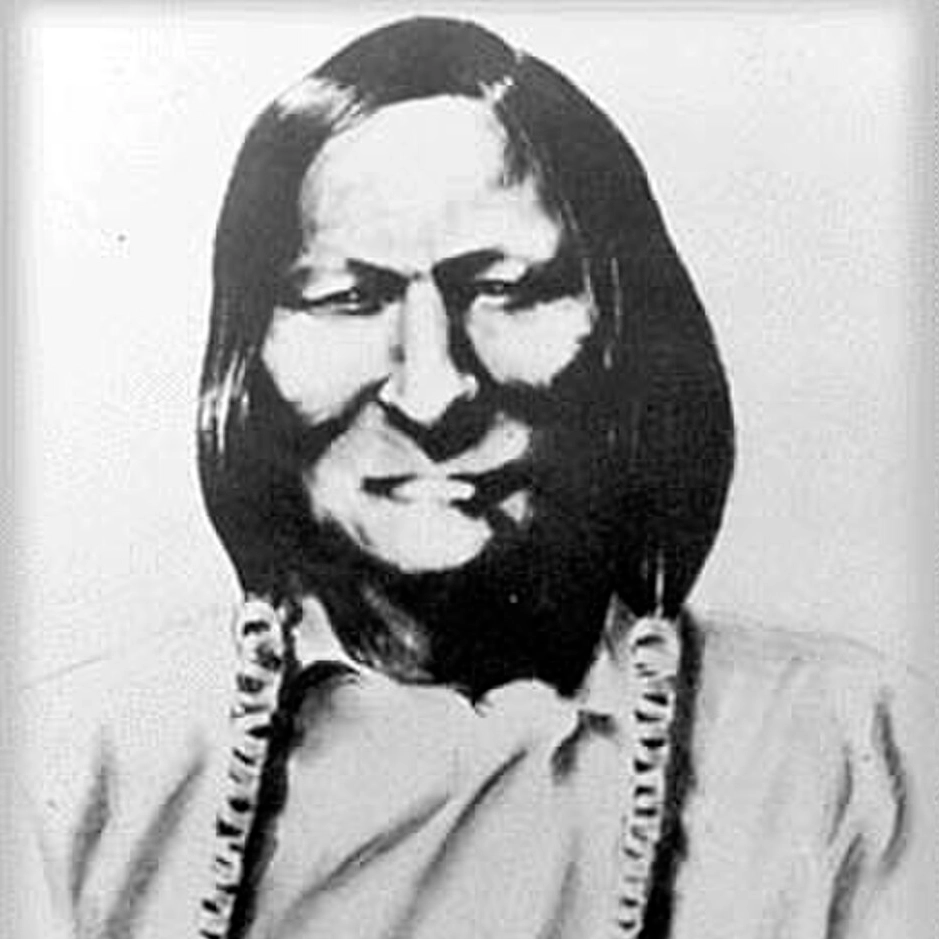
Black Kettle — A Southern Cheyenne leader who came to Camp Weld seeking peace, survived the Sand Creek Massacre, continued negotiating for peace, and was killed with his wife by U.S. soldiers at Washita River in Oklahoma in November 1868.
Wikimedia Commons

White Antelope — A Cheyenne leader who came to Camp Weld seeking peace in September 1864 and returned to his people after the council. Two months later, he was killed by Colorado troops at the Sand Creek Massacre.
Wikimedia Commons
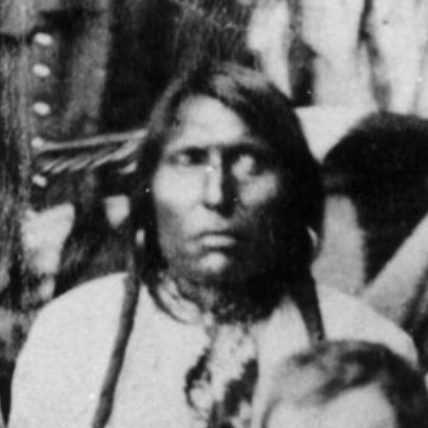
Neva — An Arapaho leader who came to Camp Weld seeking peace on behalf of his brother, Chief Left Hand / Niwot, returned to his people afterward, and was killed by Colorado troops at Sand Creek two months later, according to Southern Arapaho Tribal elders.
Denver Public Library
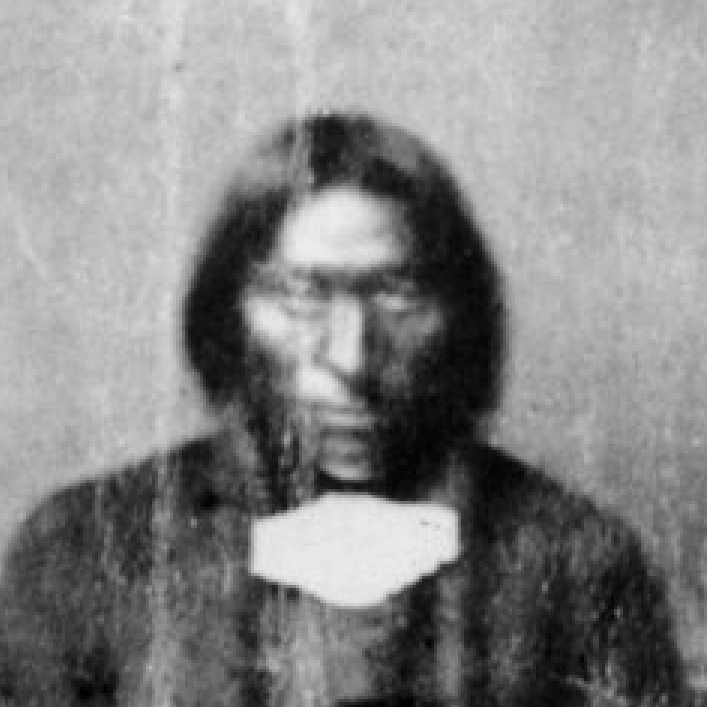
Heap of Buffalo — An Arapaho leader who came to Camp Weld seeking peace in September 1864, returned to his people afterward, and was killed by Colorado troops during the Sand Creek Massacre in November, just two months later.
Denver Public Library
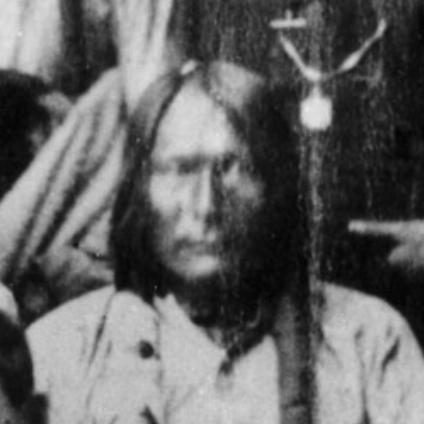
Knock-Knee — An Arapaho leader who came to Camp Weld seeking peace in September 1864, returned to his people afterward, and was killed by Colorado troops during the Sand Creek Massacre in November, just two months later.
Denver Public Library
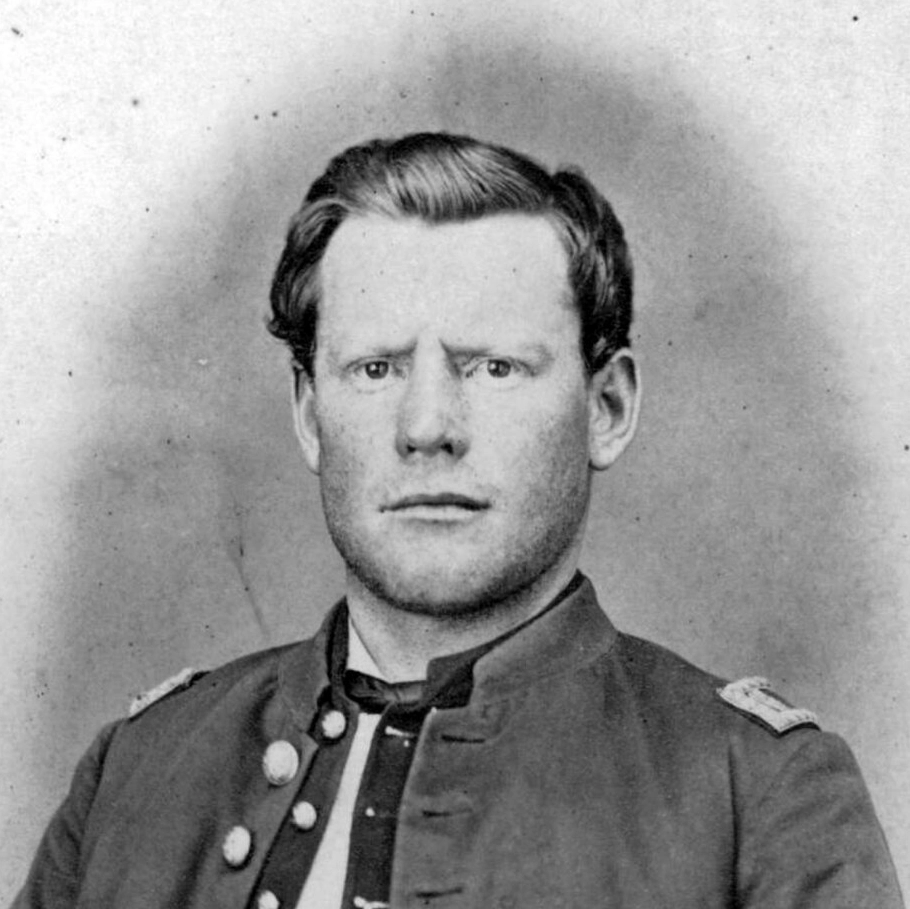
Silas Soule — A First Colorado Cavalry captain who accompanied the peace delegation to Camp Weld, refused to order his company to fire at Sand Creek, later testified about the massacre, and was murdered in Denver in 1865.
Wikimedia Commons

Edward Wynkoop — A U.S. Army officer who brought the Cheyenne and Arapaho peace delegation to Camp Weld, condemned the Sand Creek Massacre, became a federal Indian agent, and later resigned from that position after the Washita Massacre.
Wikimedia Commons
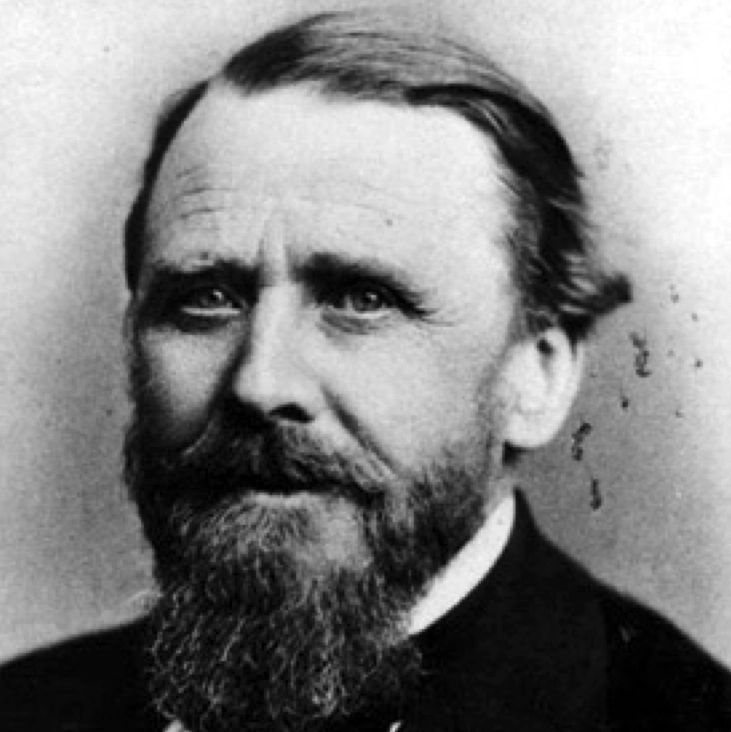
John Evans — Colorado’s territorial governor, who met the peace delegation at Camp Weld and refused to make peace, faced federal scrutiny over his actions surrounding Sand Creek and was removed from office the next year, in 1865.
Wikimedia Commons
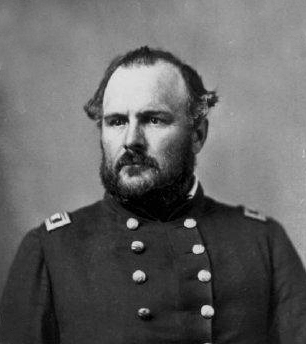
John Chivington — Colorado’s military commander, who met the peace delegation at Camp Weld and led the troops that attacked Sand Creek two months later; federal investigations condemned his conduct, but he was never criminally punished for the massacre.
Wikimedia Commons
Help Tell the Fuller History
Important historical records often remain preserved within private family papers, photographs, diaries, and collections. In the spring of 2000, handwritten letters by Capt. Silas Soule and Lt. Joseph Cramer were discovered in a trunk in an Evergreen, Colorado, attic. These letters documented how both officers protested directly to Colonel Chivington before the attack, warning him that the assault would be murder, and subsequently refused to let their companies participate in the massacre.
Read before a U.S. Senate subcommittee on Sept. 14, 2000, and reported by Colorado newspapers, including the Rocky Mountain News, these contemporary eyewitness accounts provided crucial evidence about the events at Sand Creek and the internal military opposition to the attack. The letters ultimately proved instrumental in the federal effort to identify and establish the Sand Creek Massacre National Historic Site. Today, the Soule and Cramer letters are a centerpiece of the Sand Creek Massacre exhibit at History Colorado in Denver.
If you have letters, diaries or other materials related to Camp Weld and Sand Creek, please consider sharing them with a public archive, such as History Colorado, to help build a more complete and documented historical record.
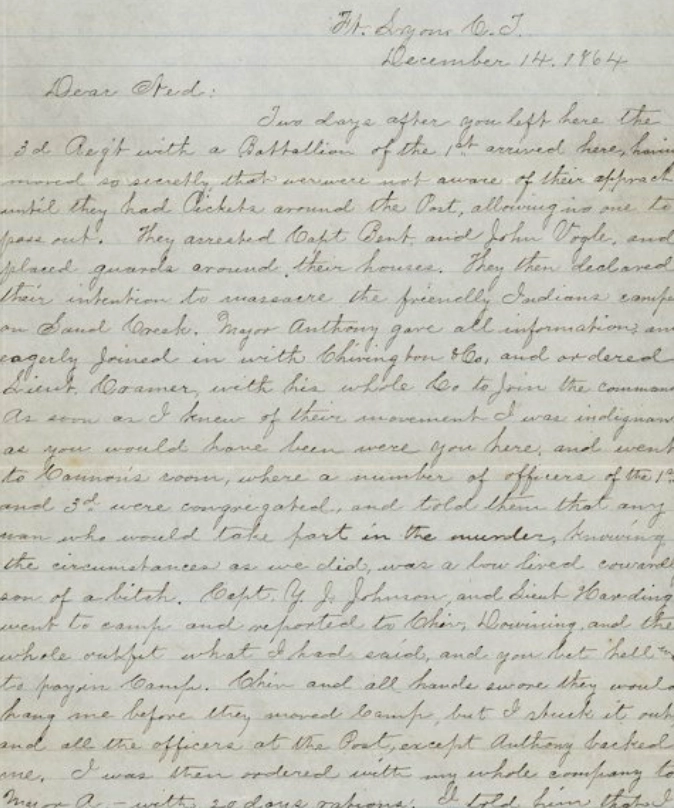
A Dec. 14, 1864, letter from Capt. Silas Soule to Maj. Edward Wynkoop documenting the atrocities at Sand Creek. With roughly 675 men participating in the Nov. 29, 1864, massacre, other firsthand records may still survive in family papers and private collections, capable of telling a deeper and fuller story of Colorado’s connections to the Sand Creek Massacre.