Skip to content
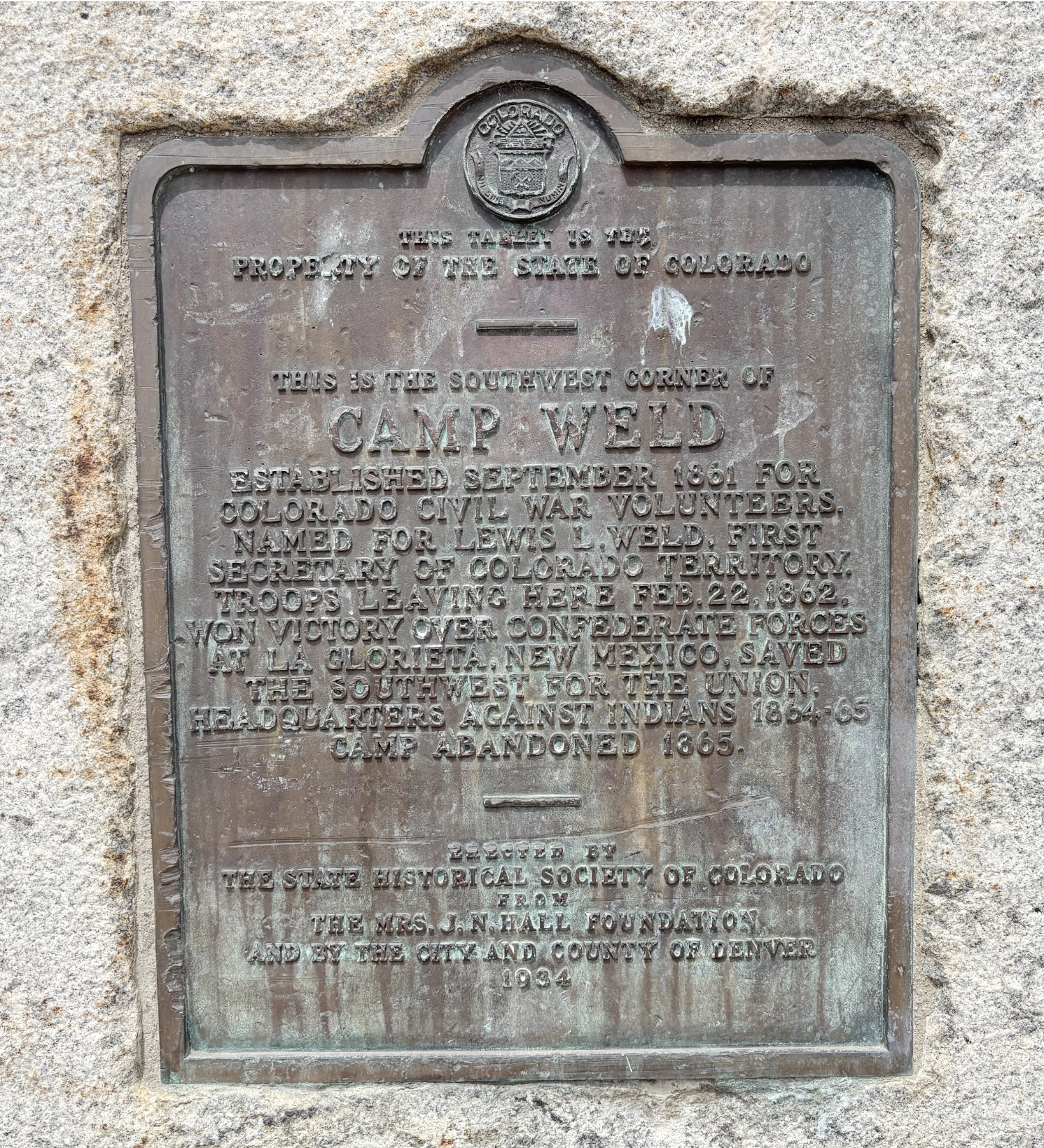
1934 Camp Weld historical marker at Eighth Avenue and Vallejo Street in Denver
The 1934 Camp Weld marker reflected how Denver remembered the 1864 conflict involving troops based at Camp Weld: “Headquarters Against Indians 1864–1865.” It omitted how troops from Camp Weld helped provoke a chain of violence in 1864 that brought Cheyenne and Arapaho leaders to Camp Weld seeking peace that September and ultimately culminated in the Sand Creek Massacre.

Camp Weld in theBurnham Yard Cultural Landscape

Denver's current Burnham Yard planning area encompasses Camp Weld's historic 30-acre footprint, while recent Denver Broncos stadium renderings suggest the proposed stadium boundaries likely intersect the Camp Weld historical marker that the city and state installed at Eighth and Vallejo in 1934.

Camp Weld has important Civil War history, but it is also where Cheyenne and Arapaho leaders met Colorado Territory Gov. John Evans and Col. John Chivington seeking peace. As Tribal Elders say in a Sand Creek Massacre exhibit now at History Colorado: “Evans and Chivington betrayed us in the worst possible way. Just months later, more than 230 peaceful Cheyenne and Arapaho women, children, and elders were murdered at Big Sandy Creek by U.S. troops.”

Burnham Yard Planning and the Denver Broncos Stadium ProposalThe City of Denver is planning the future of Burnham Yard while the Denver Broncos propose a new stadium on the 58-acre former railyard.

The City of Denver launched the Burnham Yard Small Area Plan in October 2025 to create a 20-year community vision for the 58-acre former railyard and surrounding area. The city intends to conclude the process with anticipated plan adoption near the end of 2026.

In September 2025, the Denver Broncos, City of Denver and State of Colorado announced Burnham Yard as the team's preferred site for a new stadium and mixed-use district. The Broncos have since released updated preliminary plans for the area, including new streets, parks and development around the proposed stadium, while emphasizing that the plans will continue to evolve through city review and community engagement.

Camp Weld is part of this changing cultural landscape. Historical accounts repeatedly placed the camp on the Denver & Rio Grande railroad-shop grounds that became Burnham Yard, while the 1934 Camp Weld marker at Eighth Avenue and Vallejo Street sits within the broader area now being planned for change. In July 2026, Cheyenne and Arapaho elders shared comments with the City of Denver and the Denver Broncos about the importance of Camp Weld and its role in the Sand Creek Massacre, with an invitation to collaborate to tell deeper histories of the land.

Camp Weld's 1861 Historic FootprintAn 1861 Rocky Mountain News account describing the 30-acre camp's size and location along the east bank of the South Platte River.

Established in 1861, Camp Weld served as a base for Colorado military units during the Civil War. An Oct. 14, 1861, Rocky Mountain News article said the camp's buildings would enclose a square “about eight hundred yards in length on each side.” Ten days later, another Rocky Mountain News article provided further geographic detail, describing Camp Weld as a 30-acre site “situated on the south or east bank of the Platte, about two miles from the centre of the city and on a spread of table land some thirty feet above the level of the river.” The paper said its buildings occupied “four sides of what is nearly a square.” Jerome Smiley, in his 1901 history of Denver, also placed Camp Weld within what became the Denver & Rio Grande railroad-shop landscape, today known as Burnham Yard.

Newspapers Place Camp Weld in Burnham YardEarly 1900s newspaper accounts repeatedly placed Camp Weld on the Denver & Rio Grande shop grounds, today known as Burnham Yard.

The Denver & Rio Grande Railway began building south from Denver in 1871, with Burnham Yard—named for a Philadelphia locomotive executive—becoming a key hub for the railroad. In the early 1900s, Denver newspapers repeatedly placed Camp Weld on the Denver & Rio Grande shop grounds, today known as Burnham Yard.

  • 1901 — Rocky Mountain News, Jan. 27, 1901: Camp Weld, where the Denver and Rio Grande shops are now located.
  • 1909 — Rocky Mountain News, April 23, 1909: “Camp Weld, where the Denver & Rio Grande shops are now located.”
  • 1910 — Pueblo Sun, Jan. 8, 1910: Camp Weld was a barracks that stood on the ground where the D. & R. G. R. W. shops now stand.
  • 1920 — Rocky Mountain News, July 11, 1920: “This camp was where the Burnham shops are at present.”
  • 1923 — Rocky Mountain News, Feb. 16, 1923: “Camp Weld, then located where the Denver & Rio Grande Western railroad shops now stand.”
  • 1924 — Rocky Mountain News, Aug. 6, 1924: “The Denver & Rio Grande Western shops, on the location of what used to be Camp Weld.”
  • 1929 — Colorado Historic Newspapers, July 29, 1929: “The Denver & Rio Grande Western shops at Burnham, the site of Camp Weld of Civil War days.

A 1930 article from the Colorado Historical Society—now History Colorado—said the only remaining Camp Weld building stood at the southern end of “Officers' Row,” near the present-day corner of W. 8th Avenue and Vallejo Street.

Civil War Discovery Near Camp Weld MarkerCivil War-era objects unearthed near the Camp Weld marker during a 1937 viaduct construction project.

While working on a viaduct construction project over the Denver & Rio Grande Western tracks at West Eighth Avenue and Vallejo Street, workers uncovered Civil War-era items—including an old leather boot, a military bayonet, a rusty gun barrel and a beaver trap—according to The Denver Post.

The items, which were given to the Colorado State Historical Society, were reportedly found about seven feet underground “within a few feet” from the Camp Weld marker at Eighth and Vallejo. The newspaper reported that the “relics” were the first ever found on the site of Camp Weld.

Camp Weld's Possible Overlap with the New Broncos StadiumWhy the 1934 marker and a 1937 discovery of Civil War-era artifacts suggest Camp Weld overlaps the proposed stadium area.

Using the 1934 marker as a reference—a location where construction workers found Civil War-era items in 1937—Camp Weld's approximately 30-acre historic footprint could have extended north past Mulberry Street and east past Tejon Street, likely overlapping the proposed stadium area.

A March 2026 Denver Broncos Infrastructure Master Plan places the Camp Weld marker within the project's infrastructure-planning boundaries, while updated August 2026 stadium renderings suggest the western edge of the proposed stadium area may intersect Eighth Avenue and Vallejo Street, where the marker stands.

CAMP WELD AND BURNHAM YARD

“Camp Weld was a barracks that stood on the ground where the [Burnham Yard] shops now stand,” a veteran told the Pueblo Sun in 1910, one of seven articles that placed Camp Weld on the Denver & Rio Grande shop grounds, today known as Burnham Yard. The veteran also recalled how military units at Camp Weld participated in the killing of Cheyenne people in May 1864.