Skip to content

Memory and Land

Defense and Celebration of the Sand Creek Massacre

For generations, Denver and Colorado institutions and communities defended and celebrated the Sand Creek Massacre and massacre participants. As the Colorado Miner wrote in 1879: “The [Third Colorado Cavalry] they charged the Arapahoe [and Cheyenne] camp at Sand Creek and killed five hundred of them… ought to be celebrated in Colorado with as much fervor as the Fourth of July.”

In Denver, soldiers returned to Camp Weld in December 1864 and later displayed body parts taken from Sand Creek as trophies, while the Denver City Council formally thanked the officers and soldiers who participated in the massacre. Public celebration continued for decades, from an 1883 City Hall gathering honoring John Chivington to an 1898 reenactment of Sand Creek at City Park. The Colorado Historical Society displayed Chivington’s portrait in a dedicated “Sand Creek corner” at the State Capitol.

Even in 1941, Denver officials proposed naming a major street “Chivington Boulevard”. The Denver City Council ultimately rejected the proposal following a protest from a state representative and Sand Creek descendant.

Colorado’s official reckoning with Sand Creek came much later: Gov. John Hickenlooper formally apologized on behalf of the people of Colorado in 2014, 150 years after the massacre. In 2021, Gov. Jared Polis formally rescinded Territorial Gov. John Evans’ 1864 proclamations calling on Coloradans to pursue and kill Native people.
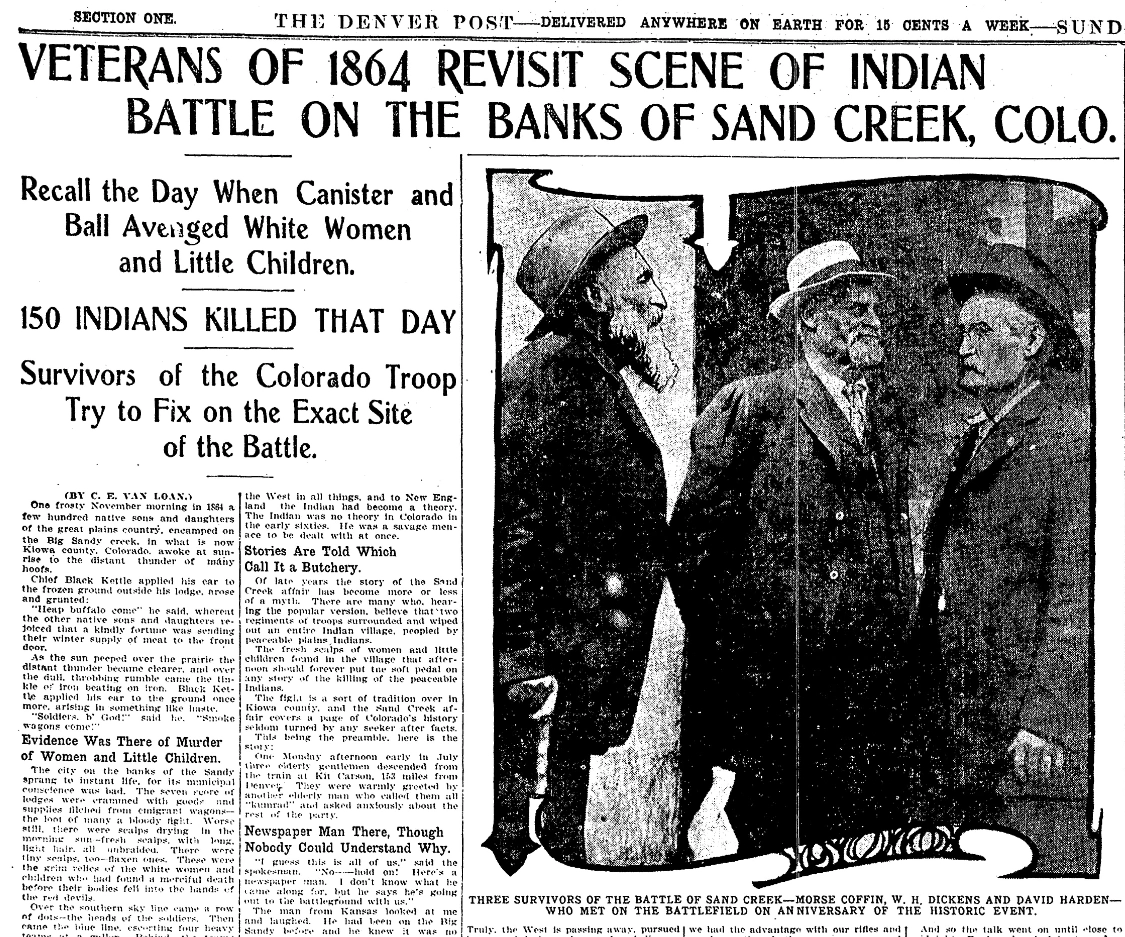
1908 Denver Post newspaper clipping about Sand Creek veterans returning to the massacre site
Denver was not alone in valorizing Sand Creek. Boulder County Sand Creek veterans later held reunions, and in 1908 several Boulder County participants set out to locate the massacre site. One man told the Denver Post in 1908: “[Sand Creek] wasn’t nice work, but it had to be done.… It was a foregone conclusion that when the white man came in the Indian had to move. He fought us as long as he could, but we had better guns and more of them, and—well, he’s gone.”

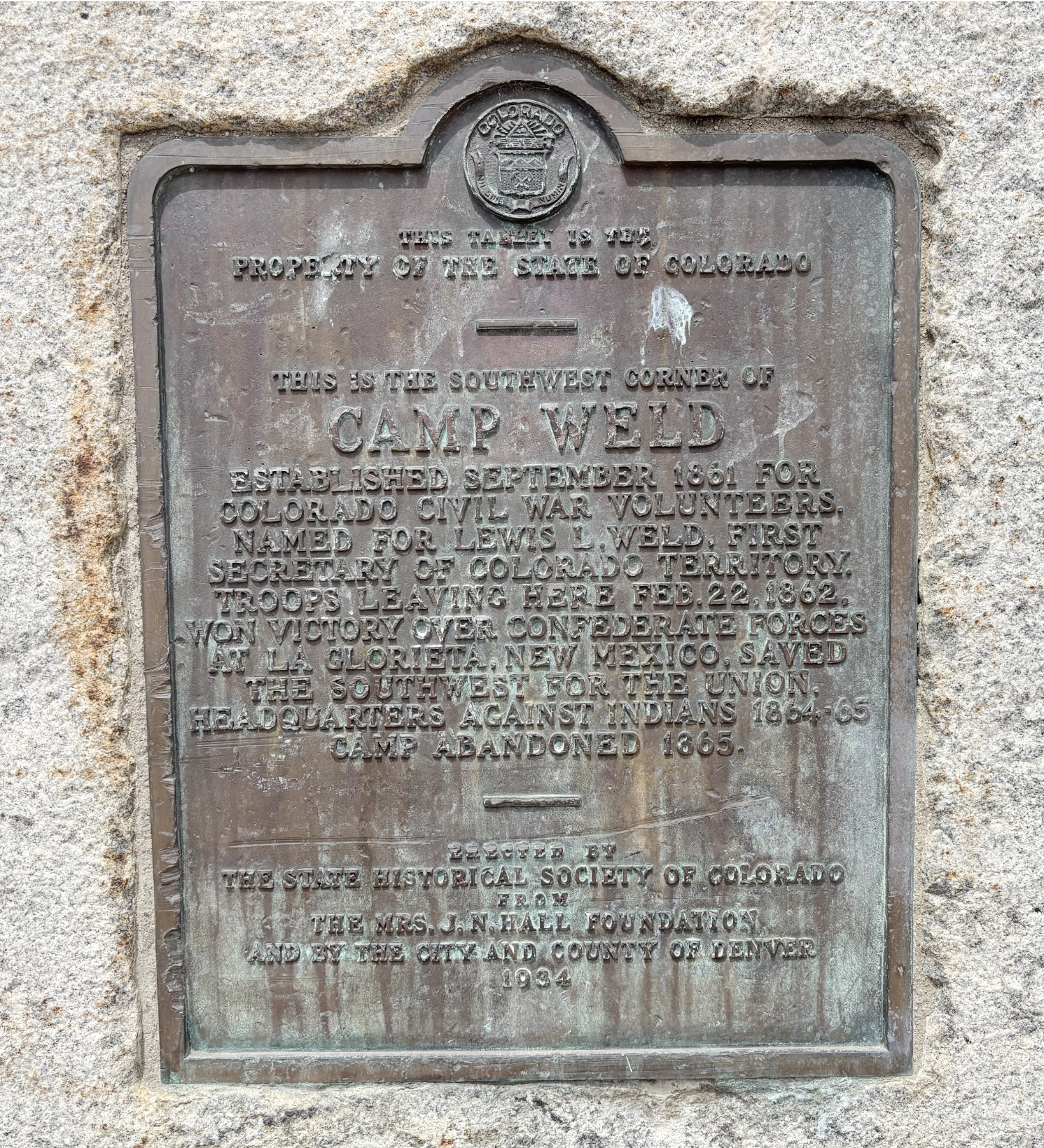
The 1934 Camp Weld Historical Marker

In February 1934, the state and city installed a three-ton Cotopaxi granite marker at Eighth Avenue and Vallejo Street during a public dedication attended by Colorado Gov. Ed C. Johnson and Denver Mayor George D. Begole. Elbridge B. Sopris, a Sand Creek Massacre participant, who continued to defend the attack decades later, attended as an honored guest.

Sopris, a member of a Denver-based unit that participated in the Sand Creek Massacre, told the Rocky Mountain News in 1927 about celebrations in Denver after the troops returned: “Sure, there were plenty of scalps and I suppose plenty of dancing. The people of Denver had plenty of reasons to be jubilant over the wiping out [of Cheyenne and Arapaho people].”

Sopris also said of Sand Creek: “Certainly it was a massacre. When we started out, everybody told us to ‘kill em all.’... We would have killed a lot more if plans had worked out right.”

1934 Camp Weld historical marker at Eighth Avenue and Vallejo Street in Denver
The 1934 Camp Weld marker reflected how Denver remembered the 1864 conflict involving troops based at Camp Weld: “Headquarters Against Indians 1864–1865.” It omitted how troops from Camp Weld helped provoke a chain of violence in 1864 that brought Cheyenne and Arapaho leaders to Camp Weld seeking peace that September and ultimately culminated in the Sand Creek Massacre.

Camp Weld Memorial Proposal & 1962 Structure Demolition

In July 1960, The Denver Post reported that a remaining Camp Weld building was located at the “west end of the W. 8th Ave. viaduct” and could be “considered the most historic structure left from Denver’s earliest days.” At the time, the building stood in an area proposed for “Urban Renewal clearance and redevelopment into an industrial area,” according to the newspaper.

State Historian Agnes Wright Spring publicly urged the state to acquire the property and convert it into a historical museum. She also told The Denver Post in 1960: “It would be an ideal location for a small park in the midst of a promising industrial area.”

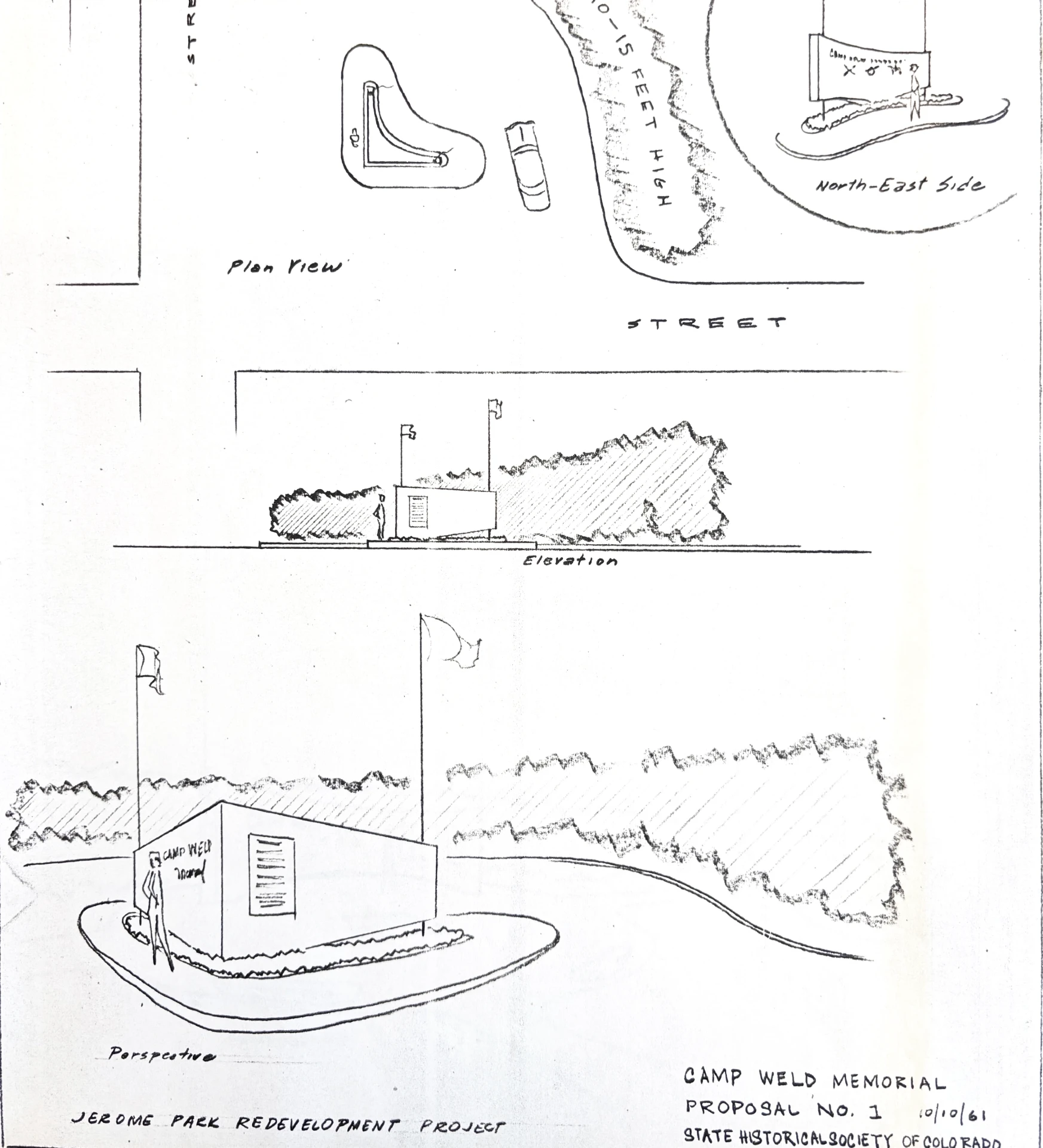
Throughout 1961, Denver Urban Renewal Authority Director Robert Cameron exchanged letters with Colorado Historical Society President Maurice Frink about the memorial, and the state developed two detailed sketches, including benches and a flagpole, for a proposed Camp Weld memorial.

The plans emerged during a period when Colorado’s public interpretation of Sand Creek remained deeply sympathetic to the men who carried it out. That same year, the University of Colorado in Boulder named a residence hall for David Nichols, a Boulder man who participated in the Sand Creek Massacre. The university renamed the building Cheyenne and Arapaho Hall in 1989. In a 1965 account, an author wrote that Colorado State Historical Society historian Agnes Wright Spring told him: “Some of the best men of early Colorado history were with Chivington at Sand Creek.”

Despite public pleas to preserve what was believed to be the last surviving Camp Weld building, the Colorado Historical Society abandoned the memorial effort in 1962. Frink instead told The Denver Post that a “tiny park” would be set aside through the Urban Renewal Program and that a flagpole, bench and marker would commemorate Camp Weld. The proposed park and memorial were never built, and the City of Denver demolished the structure in 1962.

1961 sketch for a proposed Camp Weld memorial in Denver
Internal city notes for the proposed Camp Weld memorial in the early 1960s, available at History Colorado, raised the question of whether the state and city should honor John Chivington, who ordered Colorado troops to attack Cheyenne and Arapaho people at Sand Creek, where 675 Colorado men murdered and mutilated Cheyenne and Arapaho People on Nov. 29, 1864. (Original materials held by History Colorado)

Camp Weld in Denver versus Fort Chambers near Boulder

Tribal Representatives from the Cheyenne and Arapaho Tribes, Northern Arapaho Tribe and Northern Cheyenne Tribe have participated in in-depth consultations with the City of Boulder since March 2022 regarding Fort Chambers, a site with deep connections to the Sand Creek Massacre.

Tribal Representatives from the Cheyenne and Arapaho Tribes told City of Denver staff and Denver Broncos in July 2026 that Camp Weld is just as important—if not more important—than Fort Chambers near Boulder.

In June 1864, Boulder community members built Fort Chambers amid anti-Native hysteria and exterminationist rhetoric. Two months later, more than 100 men from across Boulder County mobilized as Company D of the Third Colorado Cavalry. On Oct. 10, 1864—12 days after Cheyenne and Arapaho chiefs sought peace at Camp Weld—Company D soldiers launched an unprovoked attack on a Cheyenne camp at Buffalo Springs, killing and mutilating 10 Cheyenne men, women and children. Men from Company D later participated in the Sand Creek Massacre on Nov. 29, 1864, with the Boulder Community immediately defending the massacre in January 1865 and celebrating it through at least 1959 when community members erected a monument honoring Fort Chambers.

Following extensive Tribal consultation and community engagement, the City of Boulder released an interpretive framework for the Fort Chambers site to guide an interpretive trail centered on learning, reflection and the land’s connections to the Sand Creek Massacre.

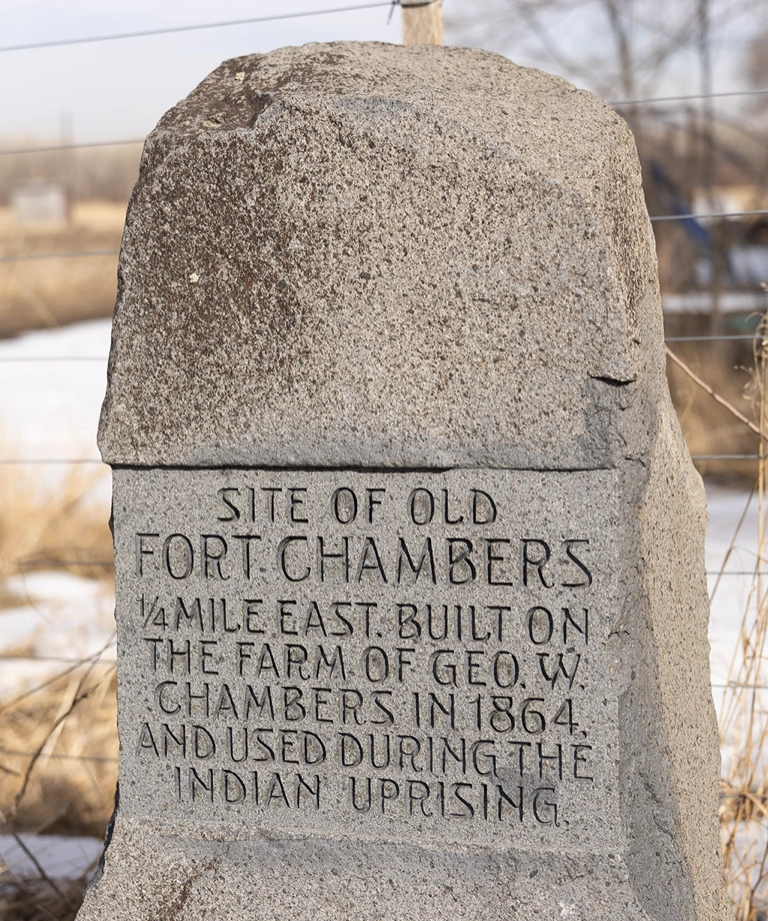
The stone Fort Chambers marker reading Site of Old Fort Chambers
In 2023, Boulder removed the 1959 Fort Chambers marker because its reference to an “Indian Uprising” perpetuated a false account of 1864. The marker broke during removal—a metaphorical break with that older narrative—and Boulder is now considering returning it to the site with new interpretation as part of a Tribal-guided interpretive experience at its Fort Chambers-Poor Farm property.

Camp Weld, Sand Creek, Burnham Yard and Land Patents

While Article 6 of the October 1865 Treaty of the Little Arkansas promised reparations to Sand Creek Massacre survivors—which never came—federal land patents were issued in the following months across the Camp Weld and Burnham Yard area. Several involved men connected to the history of the Sand Creek Massacre.

Those include Alexander Cameron Hunt, who acquired a 160-acre federal land patent in February 1866 for a tract that now encompasses much of the historic Burnham Yard. Serving as U.S. Marshal for Colorado Territory during the massacre — and later as Territorial Governor — Hunt testified before Congress about atrocities committed at Sand Creek.

In November 1865, Langdon Clark received a U.S. land patent for land covering much of what is now the La Alma Lincoln Park neighborhood. He was a member of Company A, Third Colorado Cavalry, a Denver-based unit that participated in the Sand Creek Massacre. His 160-acre land patent lies immediately east of the railyard. A month later, Elisha Milleson claimed a U.S. land patent under pre-emption rights after serving in Company A, Third Colorado Cavalry. His 40-acre land patent covered the western edge of Burnham Yard and likely much of Camp Weld’s historic footprint.

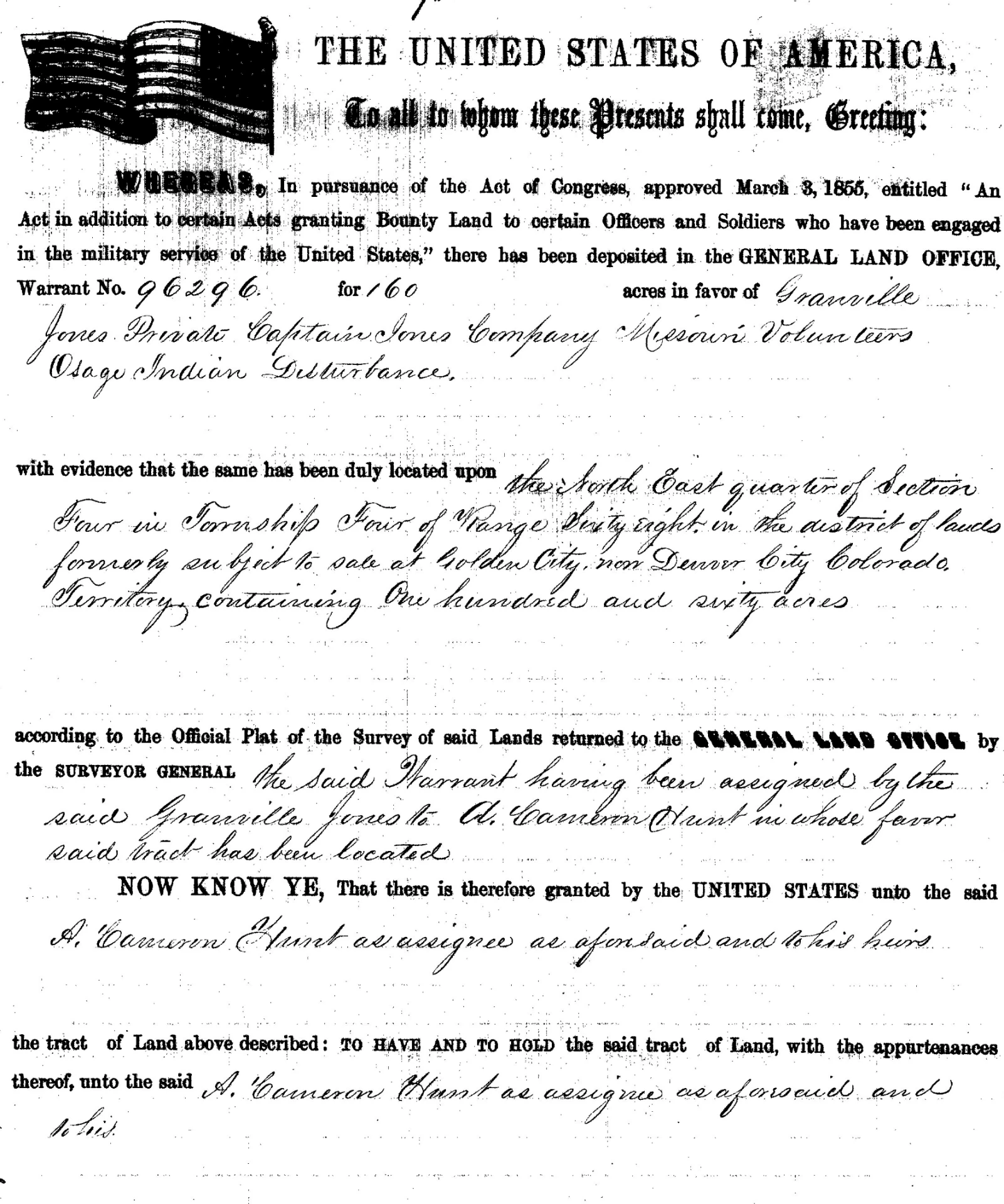
Federal bounty-land warrant document assigned to A. Cameron Hunt
Alexander Cameron Hunt, who was a Colorado governor, acquired his 160-acre parcel covering much of today’s Burnham Yard in 1866 using a military bounty-land warrant he purchased from another veteran, who had earned it for service during the “Osage Indian disturbance.”