Had Gov. John Evans taken a conciliatory approach at Camp Weld, Colorado history might have unfolded very differently. Cheyenne and Arapaho leaders had come to Denver asking for peace, and Evans had an opportunity to pursue it. He refused.
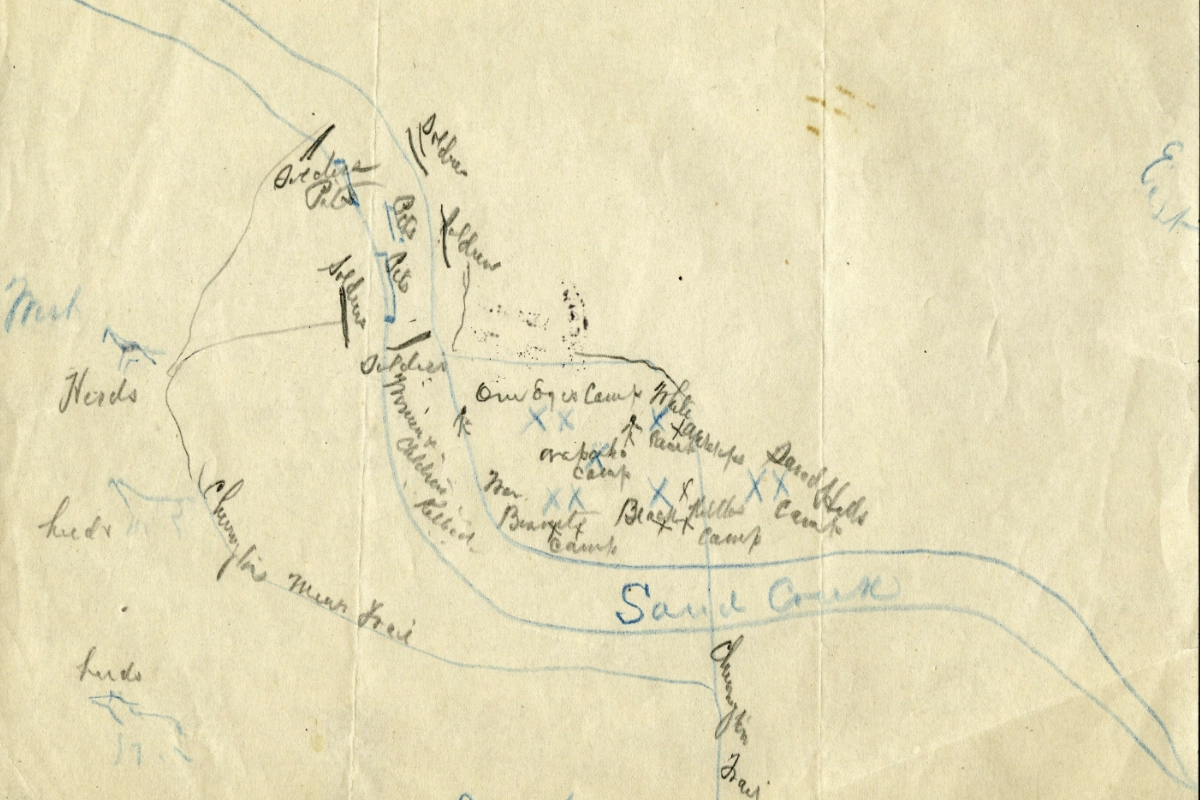
George Bent, a survivor of the Sand Creek Massacre, later drew maps of the attack showing the Cheyenne and Arapaho village, the sandpits where people sought protection and the movements of Colorado troops. Bent’s maps became important historical evidence in later efforts to locate and understand the massacre site.
Bent-Hyde Papers, Rare and Distinctive Collections, University of Colorado Boulder Libraries
The Road from Camp Weld to Sand Creek—and Back
Chivington Marches Toward Big Sandy Creek — How Chivington sealed off Fort Lyon and overruled the officers who warned him that attacking the surrendered camp would be murder.
Instead, Evans handed his responsibility to make peace at Camp Weld to John Chivington. Following a covert march across snow-covered plains, Col. John M. Chivington's command surprised the garrison at Fort Lyon near present-day Lamar, Colo., on the morning of Nov. 28, 1864, immediately sealing the post with a picket line to prevent anyone from warning the Native camps.
During the evening of Nov. 28, Lt. Joseph A. Cramer, supported by other dissenting officers at Fort Lyon, directly confronted Chivington and warned him that attacking the surrendered camp would constitute murder. Enraged by the opposition, Chivington paced the room and cursed men sympathetic to Native people. That night, Chivington ordered men of the Third Colorado Cavalry and First Colorado Cavalry toward the Cheyenne and Arapaho camp at Big Sandy Creek, where people had gathered under assurances of military protection.
A Massacre — What Cheyenne and Arapaho Elders say about the murder of more than 230 people at Big Sandy Creek and the losses that followed.
Cheyenne and Arapaho Elders explain what followed in the History Colorado Sand Creek Massacre exhibit in Denver: “They told us [at Camp Weld] if we went to Big Sandy Creek and stayed there, we would be considered peaceful and would be protected by U.S. troops. But Evans and Chivington betrayed us in the worst possible way. Just months later, more than 230 peaceful Cheyenne and Arapaho women, children, and elders were murdered at Big Sandy Creek by U.S. troops.”
At least 23 Cheyenne and five Arapaho chiefs—including White Antelope, who came to Camp Weld seeking peace, and Chief Left Hand, a prominent Arapaho chief committed to peace who sent his brother Neva to Camp Weld—were killed in the Sand Creek Massacre, according to the exhibit. Developed with Cheyenne and Arapaho Tribal Elders—including Elders who recently shared perspectives on Camp Weld with Denver Broncos and City of Denver staff—the exhibit also explains the consequences: “Without their strong voices and leadership, our people were less able to resist the military campaigns and forced removals from our homelands that followed the massacre,” the Elders said.
Third Regiment Returns to Camp Weld — How the Third Colorado Cavalry returned to Denver after Sand Creek and turned the homecoming into a public exhibition of scalps and human remains.
Following the Sand Creek Massacre, the Third Colorado Cavalry returned to Denver and Camp Weld on December 22, 1864, according to a diary kept by Major Hal Sayr of the Third Colorado Cavalry and later published in the Colorado Historical Society’s Colorado Magazine. Amid the Third Regiment’s arrival at Camp Weld near Denver, the city quickly devolved into a grotesque revelry where Indian scalps became “as thick... as toads in Egypt,” according to the Rocky Mountain News, as soldiers eagerly traded and exhibited them.
A 1927 retrospective article recalled the homecoming as Denver’s “$30,000,000 scalp carnival,” detailing how the returned troops thronged the streets, hotels, and saloons with their gory plunder. This widely publicized celebration included soldiers parading with human body parts as trophies and stringing 100 scalps across a Denver theater stage, sparking immediate nationwide horror and federal condemnation.