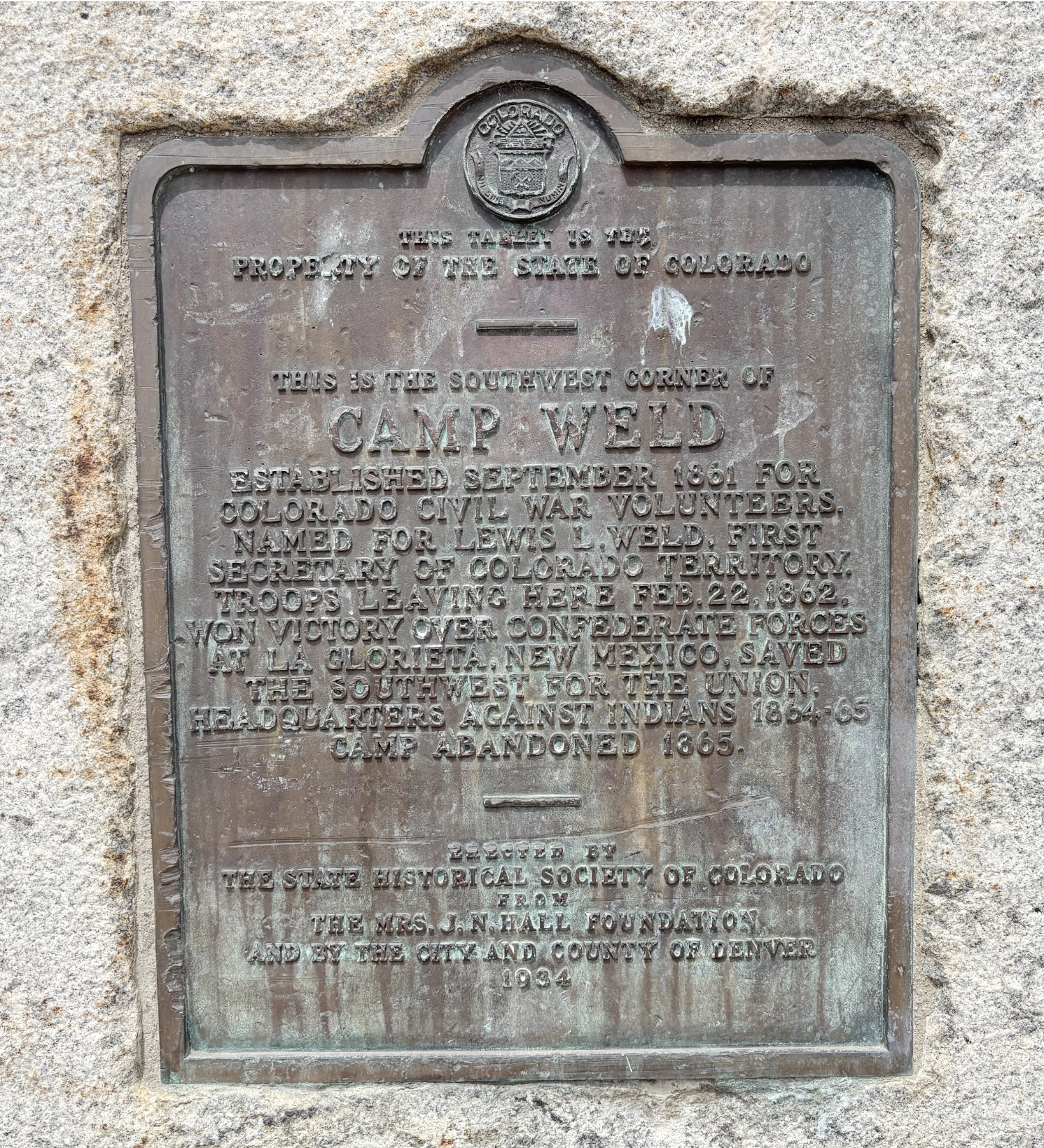
The 1934 Camp Weld Historical Marker
In February 1934, the state and city installed a three-ton Cotopaxi granite marker at Eighth Avenue and Vallejo Street during a public dedication attended by Colorado Gov. Ed C. Johnson and Denver Mayor George D. Begole. Elbridge B. Sopris, a Sand Creek Massacre participant, who continued to defend the attack decades later, attended as an honored guest.
Sopris, a member of a Denver-based unit that participated in the Sand Creek Massacre, told the Rocky Mountain News in 1927 about celebrations in Denver after the troops returned: “Sure, there were plenty of scalps and I suppose plenty of dancing. The people of Denver had plenty of reasons to be jubilant over the wiping out [of Cheyenne and Arapaho people].”
Sopris also said of Sand Creek: “Certainly it was a massacre. When we started out, everybody told us to ‘kill em all.’... We would have killed a lot more if plans had worked out right.”