Camp Weld Memorial Proposal & 1962 Structure Demolition
In July 1960, The Denver Post reported that a remaining Camp Weld building was located at the “west end of the W. 8th Ave. viaduct” and could be “considered the most historic structure left from Denver’s earliest days.” At the time, the building stood in an area proposed for “Urban Renewal clearance and redevelopment into an industrial area,” according to the newspaper.
State Historian Agnes Wright Spring publicly urged the state to acquire the property and convert it into a historical museum. She also told The Denver Post in 1960: “It would be an ideal location for a small park in the midst of a promising industrial area.”
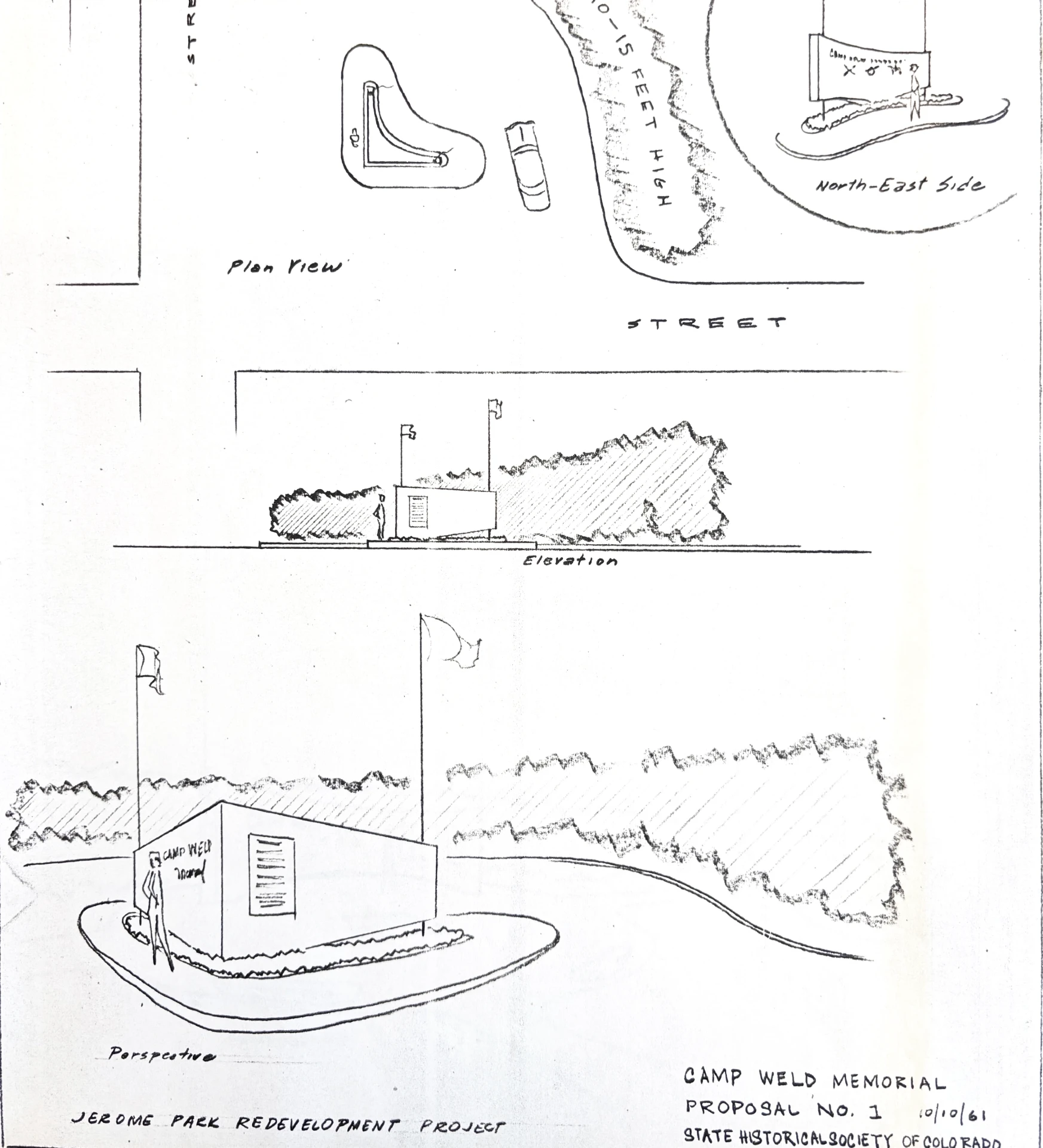
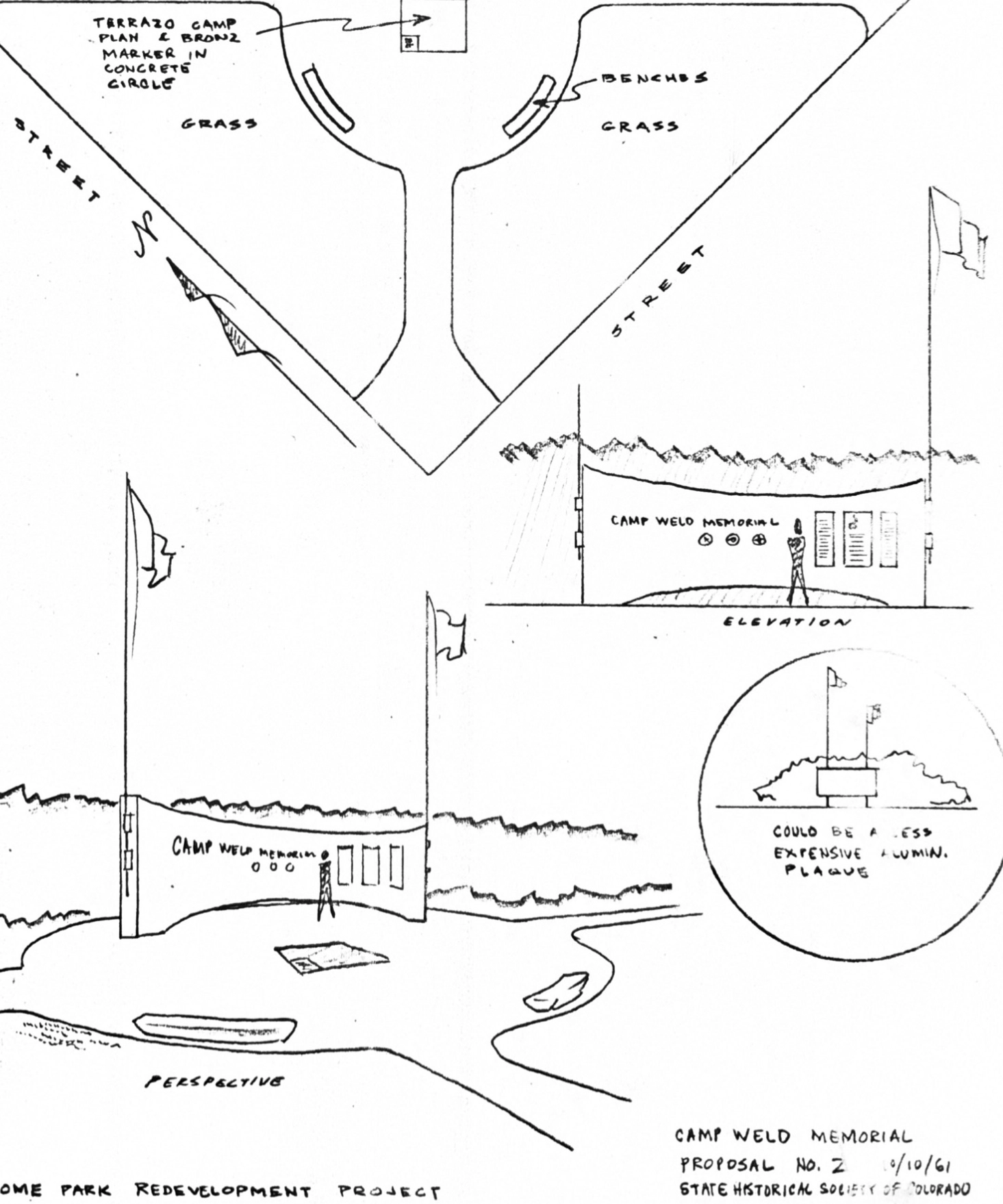
Throughout 1961, Denver Urban Renewal Authority Director Robert Cameron exchanged letters with Colorado Historical Society President Maurice Frink about the memorial, and the state developed two detailed sketches, including benches and a flagpole, for a proposed Camp Weld memorial.
The plans emerged during a period when Colorado’s public interpretation of Sand Creek remained deeply sympathetic to the men who carried it out. That same year, the University of Colorado in Boulder named a residence hall for David Nichols, a Boulder man who participated in the Sand Creek Massacre. The university renamed the building Cheyenne and Arapaho Hall in 1989. In a 1965 account, an author wrote that Colorado State Historical Society historian Agnes Wright Spring told him: “Some of the best men of early Colorado history were with Chivington at Sand Creek.”
Despite public pleas to preserve what was believed to be the last surviving Camp Weld building, the Colorado Historical Society abandoned the memorial effort in 1962. Frink instead told The Denver Post that a “tiny park” would be set aside through the Urban Renewal Program and that a flagpole, bench and marker would commemorate Camp Weld. The proposed park and memorial were never built, and the City of Denver demolished the structure in 1962.